
Distinctive Characteristics of Japan’s Arctic Approach and Engagement with Arctic Governance
Members of Japan’s National Diet during a session in 2025. Photo: Japan’s House of Representatives
The Arctic Institute Japan Series 2026
On 16 October 2015, the Headquarters for Ocean Policy, chaired by the Prime Minister of Japan, adopted Japan’s Arctic Policy;1)Headquarters for Ocean Policy (2015). Japan’s Arctic Policy. Cabinet Decision, 16 October 2015, https://www8.cao.go.jp/ocean/english/arctic/pdf/japans_ap_e.pdf. Accessed on 30 January 2026 the nation’s first comprehensive strategy dedicated to the region. Ten years on, the physical and political landscapes of the Arctic have altered dramatically. The acceleration of climate change has led to unprecedented sea-ice reduction whilst the geopolitical stability of the region, often termed ‘Arctic Exceptionalism,’ has been severely tested following Russia’s invasion of Ukraine in 2022.
A cursory observation might suggest that Japanese policy has stagnated since the 2015 policy document itself remains unrevised. However, this view overlooks the unique structural mechanism of Japanese governance. Japan’s Arctic policy is embedded within the broader framework of the Basic Act on Ocean Policy (2007),2)Basic Act on Ocean Policy (Act No. 33 of April 27, 2007), https://www8.cao.go.jp/ocean/english/act/pdf/law_e.pdf. Accessed on 30 January 2026 which mandates a Cabinet decision on a Basic Plan on Ocean Policy every five years. It is through these periodic revisions, specifically the Third Plan (2018)3)Cabinet Office, Government of Japan (2018). The Third Basic Plan on Ocean Policy. Cabinet Decision, 15 May 2018, https://www8.cao.go.jp/ocean/english/plan/pdf/plan03_e.pdf. Accessed on 30 January 2026 and the Fourth Plan (2023),4)Cabinet Office, Government of Japan (2023). The Fourth Basic Plan on Ocean Policy. Cabinet Decision, 28 April 2023, https://www8.cao.go.jp/ocean/english/plan/pdf/plan04_gaiyou_e.pdf. Accessed on 30 January 2026 that Japan has continuously updated its Arctic strategy to adapt to shifting global realities.
This article offers an analytical overview of Japan’s Arctic policy as it has evolved since the early 2010s with particular attention to its institutional foundations and policy continuity. Tracing the trajectory of Japan’s engagement over the past decade, it shows that while the tripartite structure of the policy – Research and Development, International Cooperation, and Sustainable Use – has been maintained, the relative weighting and qualitative orientation of these pillars have shifted substantially. Rather than seeking to develop a new theoretical model, the article highlights Japan’s transition from an opportunity-driven approach, centred on expectations of new shipping routes, to a more rules-based and cooperative orientation that prioritises scientific contribution and the rule of law as primary tools of engagement. By situating these developments within the broader framework of Japan’s ocean governance, the article seeks to contribute to a clearer understanding of Japan’s role in contemporary Arctic governance debates.
The Genesis of Engagement: From Science to State Policy
The Pre-2013 Era: Scientific and Private Sector Foundations
Japan’s involvement in the Arctic predates its explicit government policy. While Japan was a signatory to the Spitsbergen (Svalbard) Treaty in 1920, its engagement throughout the 20th century was predominantly scientific rather than political. In 1990, the National Institute of Polar Research (NIPR) established a research station in Ny-Ålesund, Svalbard, and in 1991, Japan became the first non-Arctic Asian state to join the International Arctic Science Committee (IASC).
During the 1990s, while government policy on the Arctic remained undefined, interest in the region’s potential was largely driven by the private and non-governmental sectors. In this context, the Ocean Policy Research Foundation (OPRF, now OPRI-SPF), supported by the Nippon Foundation, collaborated with research institutes in Norway and Russia to conduct the International Northern Sea Route Programme (INSROP) from 1993 to 1999. INSROP accumulated a comprehensive knowledge base on the feasibility and safety of navigation along the Northern Sea Route, providing an early foundation that later informed discussions as awareness of Arctic environmental change and its implications for maritime logistic increased in Japan in the late 2000s.5)OPRI-SPF, Developing a Japan Policy towards the Arctic Ocean, https://www.spf.org/opri/en/proposal_research/proposal/201203_develop_japanpol.html. Accessed on 30 January 2026 Building on this background, OPRF-SPF released a policy proposal in March 2012 entitled “Immediate Actions Japan Should Take Toward the Sustainable Use of the Arctic Ocean.”6)OPRI-SPF, Immediate Actions Japan Should Take Toward the Sustainable Use of the Arctic Ocean, https://www.spf.org/opri/global-data/opri/recommendation/12_06_02.pdf. Accessed on 30 January 2026 Shortly thereafter, in December 2012, the Japanese government formally placed “Issues Concerning the Arctic Ocean” on its policy agenda marking a critical step toward the incorporation of Arctic issues into national ocean policy in the following year.
The 2013 Turning Point: The Second Basic Plan
The year 2013 marked a definitive turning point. Amidst growing global attention to the melting Arctic ice, Japan was granted Observer status in the Arctic Council in May 2013. Coinciding with this diplomatic breakthrough, the Cabinet adopted the Second Basic Plan on Ocean Policy (2013).7)Cabinet Office, Government of Japan (2013). The Second Basic Plan on Ocean Policy. Cabinet Decision, 26 April 2013, https://www8.cao.go.jp/ocean/english/plan/pdf/plan02_e.pdf. Accessed on 30 January 2026 Crucially, this document was the first to explicitly incorporate Arctic issues into national strategy. As cited in the plan, the government recognised that “global concern has been mounting over the impact of such changes on the global climate system and potential for use of [the] Arctic Sea Route”. At this stage, the primary policy objective was unmistakably the assessment of commercial potentials. The plan explicitly stated that observation and research should “lead to assessment of the potential for future use of Arctic Sea Route”. Thus, the early phase of Japan’s state-level engagement was characterised by an anticipation of economic opportunity.
The 2015 Arctic Policy Framework
Building upon the momentum of 2013, Japan’s Arctic Policy was formulated in 2015. It established three strategic pillars that remain in place today:
- Research and Development: Contributing to the solution of global issues through science.
- International Cooperation: Promoting the rule of law and contributing to international frameworks.
- Sustainable Use: Exploring economic possibilities, particularly the NSR and resource development.
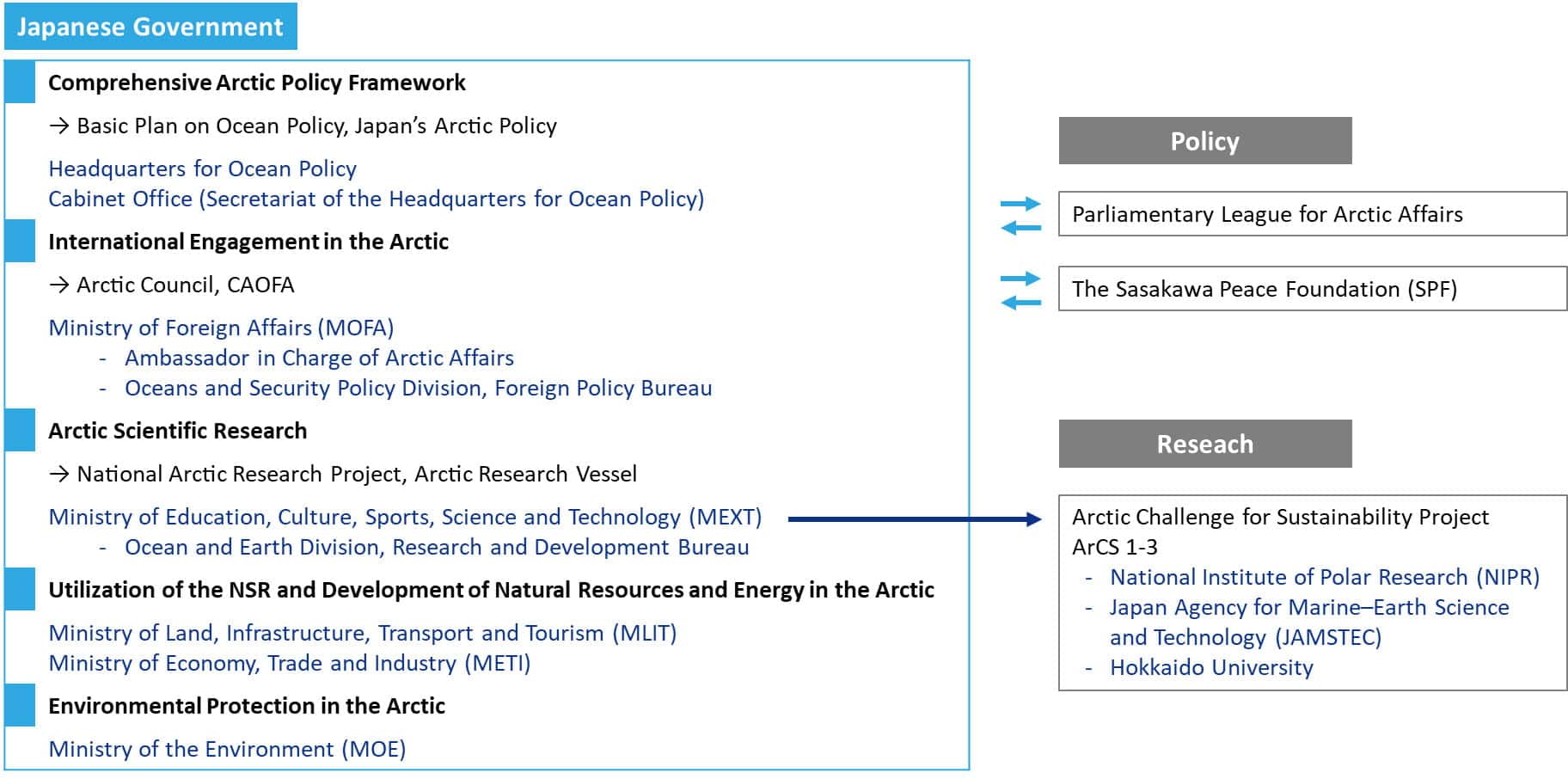
This policy framework was unique in that it was not the purview of a single ministry but was coordinated by the Cabinet Office’s Headquarters for Ocean Policy, integrating the interests of the Ministry of Foreign Affairs (MOFA), the Ministry of Education, Culture, Sports, Science and Technology (MEXT), the Ministry of Land, Infrastructure, Transport and Tourism (MLIT), the Ministry of Economy, Trade and Industry (METI) and the Ministry of the Environment (MOE). Policy developments in this period reflect a process of incremental coordination among multiple government agencies and research institutions.
Structural Evolution through the Basic Plans
The Third Basic Plan (2018): Institutional Consolidation
By 2018, the focus of Japan’s policy began to shift from pure exploration to institutional consolidation. The Third Basic Plan established Arctic policy as a distinct, major item within ocean policy measures. This period saw the strengthening of the scientific base through the Arctic Challenge for Sustainability (ArCS) project (2015–2020), which aimed to link natural and social sciences to provide data for policy-making. The Third Plan also formally initiated the consideration of a new Arctic research vessel with icebreaking capabilities. This signalled a recognition that to maintain its status as a major player (or a ‘legitimate stakeholder’), Japan required independent access to the Central Arctic Ocean, reducing reliance on foreign icebreakers.
The Fourth Basic Plan (2023): Adaptation to Geopolitical Uncertainty
The Fourth Basic Plan on Ocean Policy, adopted in April 2023, reflects the profound shock to the Arctic governance order caused by Russia’s invasion of Ukraine in 2022. With the Arctic Council’s activities temporarily paused and cooperation with Russia severed, the optimistic tone regarding economic opportunities that characterised the 2013 and 2015 documents has been replaced by a focus on stability, preparedness, and resilience. The Fourth Plan acknowledges that “the situation surrounding the Arctic is uncertain” due to the invasion. Consequently, whilst the three pillars remain intact, their interpretation has altered. The Arctic is now discussed more explicitly within the context of “Comprehensive Maritime Security,” which encompasses not only traditional defence but also economic security and the maintenance of the international maritime order. Specific targets for developing NSR infrastructure, prominent in previous plans, have been removed or toned down. The focus has shifted to “information gathering” and preparation for “all scenarios,” reflecting the high geopolitical risk.
The Transformation of the Three Pillars
This section provides an empirical analysis of how the specific content of the three pillars has evolved over the decade.
Research and Development: The Deepening of Engagement
Of the three pillars, Research and Development has seen the most consistent expansion and success. Japan has leveraged its scientific prowess as a diplomatic asset.
Continuous National Projects: The progression from the GRENE project (2011–2016) to ArCS (2015–2020) and ArCS II (2020–2025) demonstrates a long-term state commitment. The upcoming ArCS III (from 2025) aims to further enhance “social implementation” of scientific data, bridging the gap between researchers and policymakers.8)Medy Dervovic, Osamu Inagaki, Kentaro Nishimoto, Akiho Shibata, Akiho ed. (2025) Japan’s Arctic Policy 2015-25 : Suggestions for the Next Decade, ArCS II International Law Briefing Paper Series, No. 12. Kobe: Kobe University. https://da.lib.kobe-u.ac.jp/da/kernel/0100494092/0100494092.pdf. Accessed on 30 January 2026
The Construction of Mirai II: A pivotal development is the construction of the Arctic Research Vessel Mirai II. Initially a “consideration” in the 2015 policy, the decision to build was finalised in 2021. Scheduled for delivery in November 2026 and operational voyages in 2027, Mirai II will be Japan’s first research vessel capable of breaking 1.2 m of ice. This asset will allow Japan to fill the “data gap” in the Central Arctic Ocean, potentially strengthening its contributions in international rule-making.
International Cooperation: From Participation to Rule-Making
Japan’s approach to international cooperation has evolved from seeking admission (Observer status) to active shaping of the order.
Science Diplomacy: In 2021, amidst the COVID-19 pandemic and rising tensions, Japan co-hosted the Third Arctic Science Ministerial (ASM3) with Iceland.9)The Third Arctic Science Ministerial (ASM3) (8-9 May 2021), https://asm3.org/. Accessed on 30 January 2026 This underscored Japan’s capability to facilitate dialogue through science despite the challenges posed by the pandemic.
The Rule of Law: A distinctive feature of Japan’s Arctic policy is its strong emphasis on international law, particularly the United Nations Convention on the Law of the Sea (UNCLOS). Unlike some Arctic coastal states that emphasise sovereignty, Japan consistently advocates for the freedom of navigation and the status of the high seas in the Central Arctic Ocean. The entry into force of the Agreement to Prevent Unregulated High Seas Fisheries in the Central Arctic Ocean (CAOFA) in 2021 is a testament to this emphasis on the rule of law, to which Japan contributed through scientific negotiations.10)Kentaro Nishimoto (2024), Japan and the Polar Regions, Routledge Handbook of Polar Law. London: Routledge. DOI: https://doi.org/10.4324/9781003404828
Sustainable Use: A Strategic Retreat
The “Sustainable Use” pillar has undergone the most significant recalibration.
The Northern Sea Route (NSR): In 2013, the NSR was viewed as a revolutionary economic opportunity. By 2023, however, the enthusiasm had cooled significantly. The Fourth Basic Plan emphasises the risks associated with the Russian-controlled route. While not abandoning the concept, the policy has shifted to a “cautious approach,” prioritising the collection of environmental data and ensuring navigational safety over active commercial promotion.
Resources: Similarly, Japanese involvement in Russian energy projects (such as Arctic LNG 2) faces uncertainty due to sanctions. The focus has shifted towards the potential of “Blue Economy” initiatives and sustainable resource management rather than large-scale extraction.
Security and ‘International public Values’ Perspective
A critical but often understated aspect of Japan’s Arctic policy concerns its approach to security. Unlike some NATO member states, Japan’s Arctic policy documents do not articulate explicit commitments to military engagement in the region. Instead, security-related considerations are situated within broader frameworks such as comprehensive maritime security and international cooperation. Japan’s engagement with the Arctic regions can be understood as being informed by considerations related to international public values, including scientific knowledge production and the maintenance of a rules-based international order.11)Kentaro Nishimoto (2024), Japan and the Polar Regions, Routledge Handbook of Polar Law. London: Routledge. DOI: https://doi.org/10.4324/9781003404828 Consistent with this orientation, Japan’s policy documents emphasise the rule of law and international legal frameworks as important components of security governance, and do not define region-specific military postures for the Arctic.
While several European states have explicitly highlighted changes in the security environment and articulated closer alignment with NATO in their Arctic policy documents, Japan’s approach is characterised by an emphasis on maintaining low tension in the region. Rather than foregrounding specific threats, Japan’s policy documents adopt a cautious stance that prioritises monitoring developments and preserving stability. The National Security Strategy (2022) does not identify the Arctic as an independent security domain, and its only explicit reference to the region appears in the context of climate change and the increased use of Northern Sea Route.12)National Security Council, Government of Japan (2022). The National Security Strategy. Cabinet Decision, 16 December 2022, https://www.cas.go.jp/jp/siryou/221216anzenhoshou/nss-e.pdf. Accessed on 30 January 2026
Conclusion: Towards the Next Decade
Reviewing the past decade, Japan’s Arctic policy has matured from an initial, perhaps overly optimistic, interest in economic opportunities to a resilient, science-based strategy designed to withstand geopolitical shocks. The forthcoming deployment of Mirai II in 2027 represents the physical embodiment of this strategy: a capability to operate independently in the ice, generating the scientific data necessary to influence global governance.
In the face of a divided Arctic Council and a warming ocean, Japan’s distinctive approach – characterised by institutional consistency, a reliance on the rule of law, and the heavy utilisation of science diplomacy – can be understood as a stabilising force. As the policy enters its second decade, the challenge will be to maintain this delicate balance, ensuring that the Arctic remains a domain governed by law and scientific cooperation rather than power.
Hajime Kimura is a researcher in international law at Japan Agency for Marine-Earth Science and Technology (JAMSTEC). His current research focuses on Arctic science and policy.
Legal Disclaimer:
EIN Presswire provides this news content "as is" without warranty of any kind. We do not accept any responsibility or liability for the accuracy, content, images, videos, licenses, completeness, legality, or reliability of the information contained in this article. If you have any complaints or copyright issues related to this article, kindly contact the author above.
